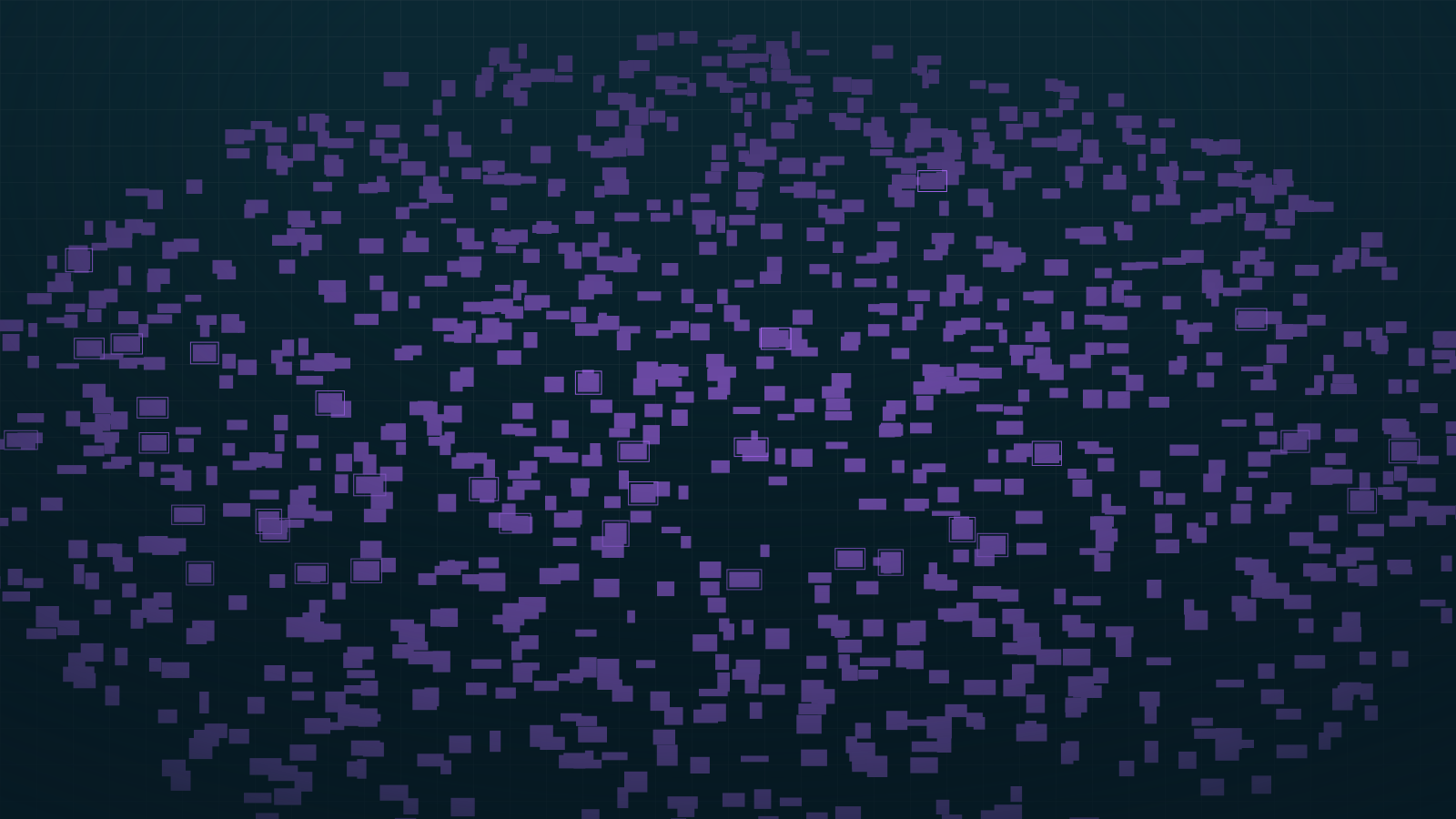

From pixels to numbers. And from numbers, to decisions.
The cameras you already have become automatic counters. The model is trained on your own images and the processing happens on site: what leaves the node is the number, not the video.
Demonstration scene. The number of detected objects is computed in real time from the objects visible in frame.
One engine, four shop windows.
Each vertical is a different configuration of the same platform: same capture, same inference at the edge, same dashboard. What changes is the class being counted and the colour it is drawn in.
Car parks
How many cars are there now, and how many there were every hour last month.
Your security camera is already recording the car park. It just needs someone to read what it sees — and that someone need not be a person.
See car park occupancy → Comptam TeulesRoofs
The exact number of tiles on a roof, from a twenty-minute flight.
No scaffolding, nobody climbing onto the roof, and a count you can take straight to the materials estimate.
See drone roof inventory → Comptam FondeigAnchorages
How many boats, exactly where, and how long they stay.
The sea is a perfect plane: four reference points are enough to turn pixels into real coordinates.
See anchored vessel counting → Guaitam ResidusWaste
An alert when bulky waste appears or the bin overflows. Within minutes.
Not next week when a neighbour complains: twenty minutes later, with a photo and the exact location.
See illegal dumping detection →The loop that makes it more accurate on your scene.
This is not a model you install and forget. It is a six-step cycle that repeats for as long as the subscription runs: capturing, curating and annotating never stop, while training, validation and deployment happen at the cadence of your plan.
- 01
Capture
Real frames of your scene, shot with the final camera and spread across days: sun, overcast, night, rain, full and empty. Variety before volume.
- 02
Curate
Every frame with detections in the uncertain confidence band is kept for review, along with the false positives you report. It costs nothing to collect and it is what feeds the retraining.
- 03
Annotate
The current model pre-annotates and a human corrects. Annotating this way costs 60 to 80 % less than starting from scratch each time.
- 04
Train
Fine-tuning on cloud GPU. A bespoke model costs a few euros of compute and under an hour.
- 05
Validate
Against a frozen test set that never enters training. No model ships without beating the previous one on that same set.
- 06
Deploy
The new model goes down to the node. On the Bàsic plan that happens once a year and on Pro twice; the first three steps do not stop in between, so by the time a retrain is due the material has been piling up for months.
The fee covers that cycle: maintaining the node and retraining the model on your scene. If the scene changes before it is due —new building work, a moved camera, a different shadow— a retrain can be brought forward.
The video stays where the camera is.
We process on the device itself and send only the number. Less data to protect, less bandwidth, less paperwork.
Frame → inference → discard. The node stores no video.
| GDPR principle | How the product meets it |
|---|---|
| Minimisation (art. 5) | In normal operation only a number or a state leaves the device. The continuous video never does. |
| Privacy by design (art. 25) | The personal datum never comes into existence outside the node. |
| Storage limitation | Frames are processed and discarded; there is no continuous recording. |
| Proportionality | The camera does not identify people: it counts objects. |
A generic model has seen millions of cars. None of them was yours.
We train on images of your scene: your angle, your optics, your shadows at six in the evening. That is why it gets right what others get wrong.
It has seen millions of internet photos. None from your pole, with your optics and your video compression.
It has seen your scene in sun and rain, full and empty. To be right on that frame, two hundred images of the real site are worth more than any generic dataset.
-
The domain gap
A public model has seen cars, but it has not seen your car park from your pole with your palm tree’s shadow at 18:40 in July. That distance is where detections get lost.
-
Variety before volume
150 to 300 images spread properly across sun, overcast, night, rain, full and empty beat 2,000 all taken at the same hour.
-
Your taxonomy, not a public dataset’s
We define the class you need to count, not the one the catalogue ships with. Your “car” may include the van that public datasets call a truck.
-
Non-negotiable validation
50 to 80 images per client are frozen and never enter training. No model ships without being compared against them.
Is your scene viable?
That is the question we answer first, and it is answered by looking at the scene: distance, optics, lighting and how many objects sit inside the frame. The form below tells you whether it is worth going on.
The number lands where you already look.
Grafana, MQTT, your own API, or a Telegram message to the crew. We are not asking you to open yet another tab.
This is what leaves the node
{
  "site":      "hotel-x-parking",
  "ts":        "2026-08-03T18:40:12Z",
  "class":     "car",
  "count":     37,
  "capacity":  48,
  "state":     "normal",
  "conf_mean": 0.91,
  "model":     "hotel-x-parking@v2.1"
}
A count fits in two bytes. That is why a node can publish over LoRaWAN from a pole with no Wi-Fi and no SIM, as long as a LoRaWAN gateway reaches it.
Let’s start with one camera.
Six weeks, one point, a real number on a real dashboard. If it works, we scale.
- Occupancy dashboard and history
- Alerts by Telegram or email
- Node maintenance
- 1 retraining per year
- Everything in Bàsic
- REST API and integrations
- 2 retrainings per year
- Business-hours SLA
- Multi-site
- Quarterly reports
- Tender support
- Support for the data protection officer
Getting started
| Feasibility study | 600 – 1,200 € | Site visit, scene analysis, written report with expected accuracy. Deducted from the project. |
| Pilot · one camera, 6 weeks | 1,500 – 2,500 € | The whole first point included: initial dataset, bespoke model, the node installed and the dashboard. No other line in this table is added on top. |
| Additional bespoke model | 1,500 – 3,500 € | Depending on the number of classes and difficulty. |
| Edge node, installed · each site from the second onwards | 900 – 1,800 € / point | Hardware, configuration, calibration and commissioning. The first site is already inside the pilot. |
| Drone campaign · roofs | 450 – 900 € / building | Flight, processing and report. |
How we work
- The pilot is invoiced, and it is deducted from the rollout if you carry on. That way the pilot is a project with real time behind it, not a demonstration that drags on.
- The monthly fee pays for maintaining the node and retraining the model on your scene. What you buy is accuracy that is kept current.
- Hardware is invoiced separately and it is yours. We keep it apart from the fee so you can see what each thing costs.
Prices exclude VAT and are indicative. The final figure is set in the feasibility study, after seeing the scene.
What people ask before deciding.
Seven questions that come up in every first conversation. We answer them here with the same figure we would give you on the phone.
Will the camera I already have work?
In most cases, yes. If it publishes an RTSP stream and sees the scene you want to count, the capture cost to you is zero: we simply add a node that reads it. The feasibility study confirms this before you buy anything.
How much does it cost to count cars with the camera I already have?
A one-camera, six-week pilot costs between 1,500 and 2,500 €, including the initial dataset, the bespoke model, the installed node and the dashboard. After that the subscription runs from 39 to 79 € per camera per month. The feasibility study beforehand costs 600 to 1,200 € and is deducted from the project.
Do the images leave my premises?
The continuous video does not: the node reads the frame, processes it and discards it, with no recording and no cloud copy. In normal operation what travels is a number or a state. There are two exceptions, both agreed before installation: the snapshot attached to an alert, which is sent only if there are no people in the scene, and the uncertain frames kept to retrain the model on your scene. If you want neither, both can be switched off.
What accuracy can I expect?
It depends on the scene, which is why we do not quote a figure before seeing it. The feasibility study delivers the expected accuracy for your specific case in writing: distance, optics, lighting and object density matter more than the model does.
How long from decision to first number?
Four to six weeks for a first point: capturing the dataset takes five to ten days, annotating and training a few more, and the rest is installation and calibration.
Does it work somewhere with no Wi-Fi and no mobile coverage?
Yes. A count fits in two bytes, so the node can publish over LoRaWAN from a pole with no SIM and no data plan. That is the difference between being able to install at a remote bin or not.
Does it detect the fill level inside the bin?
No. The camera sees the overflow outside and the bulky waste left beside it, not the level inside. For the level we fit an ultrasonic sensor inside. Better to know it before deciding.
Let’s start with one camera.
Five answers and we will tell you whether your scene is viable. No sales call in between.